The Nativity Fast of 2026 begins on 15 November and lasts until 24 December, forty days in all. For many families in Ukraine this is a time when the menu has to be planned ahead: meat, dairy and eggs disappear from the table for these weeks, and fish, beans and mushrooms become the main sources of protein. In November people most often look for the answer to one simple question: on which days of the fast is fish allowed? Below you will find the dates of Pylypivka under the new calendar, the fish days of 2026 in one table, advice on choosing fish and several dishes that are easy to make for fasting weekends.
When the Nativity Fast runs in 2026
According to the 2026 church calendar of the Orthodox Church of Ukraine (OCU), the Nativity Fast runs from 15 November to 24 December inclusive. The day before, 14 November, the Church remembers the Apostle Philip, and this is the last day before the fast, when meat and dairy are still eaten. The apostle's name also gave the fast its folk name, Pylypivka, which Ukrainians use more often than the official one. The fast ends with Christmas Eve on 24 December, and the next day, Friday 25 December, Christmas is celebrated.
The forty days of the Nativity Fast are meant as preparation for the feast, and several notable dates of the church year fall within them: the Entry of the Theotokos into the Temple on 21 November, the feast of Saint Nicholas on 6 December and Christmas Eve on 24 December. The OCU calendar also notes that no weddings are celebrated throughout the Nativity Fast and the Christmas season, up to 7 January, so families plan weddings either before the fast begins or after 7 January.
All these dates apply to those who follow the new calendar used by the OCU. People who still keep the Julian calendar fast thirteen days later, from 28 November 2026 to 6 January 2027, and their fish days shift accordingly.
What is eaten during the Nativity Fast and when fish is allowed
The Nativity Fast is one of the milder long fasts. Its basis is the same as in other fasts: no meat, milk, cheese, butter or eggs on the table. Instead, the menu is built from grains, vegetables, mushrooms, beans, bread, sauerkraut and pickles, and on certain days fish is added.
A week of Pylypivka has its own rhythm. Wednesday and Friday remain fasting days throughout the church year, and they carry the simplest menu. Under the church rule, fish, vegetable oil and a little wine are allowed on Saturdays and Sundays until 19 December, so the weekends become the fish days of the fast. The OCU calendar separately states that fish is allowed at the meal on the feast of the Entry of the Theotokos, 21 November. The feast of Saint Nicholas, 6 December, falls on a Sunday in 2026 and becomes a fish day with no extra rules needed.
The last week before Christmas is stricter. From 20 to 24 December fish is not eaten under the church rule, even at the weekend, and the table turns back to vegetables and mushrooms. That makes Saturday 19 December the last fish day of the fast in 2026.
For children, older people, pregnant women and nursing mothers, people with chronic illnesses, soldiers and those who do heavy physical work or are travelling, the fast may be eased. The extent of such easing is discussed with a priest, and for many families he is the one who helps put together a realistic menu for the forty days.
Fish days of the Nativity Fast 2026: calendar
Put the weekend rule and the feasts together and 2026 gives ten fish days. All of them fall on Saturdays and Sundays, so the shopping plan can be made for the whole fast at once.
| Date | Day of the week | Occasion |
|---|---|---|
| 15 November | Sunday | first day of the fast |
| 21 November | Saturday | Entry of the Theotokos into the Temple |
| 22 November | Sunday | |
| 28 November | Saturday | memorial Saturday for the victims of the Holodomor |
| 29 November | Sunday | |
| 5 December | Saturday | |
| 6 December | Sunday | feast of Saint Nicholas |
| 12 December | Saturday | |
| 13 December | Sunday | |
| 19 December | Saturday | last fish day of the fast |
In 2026 both major feasts of the fast, the Entry of the Theotokos and Saint Nicholas, fall on a weekend, so this year there are no extra fish days in the middle of the week. The table also shows clearly that fish comes to the table five weekends in a row. That makes planning simple: each weekend can have its own fish and its own dish, so the menu does not repeat. Saturday 28 November is the day of remembrance of the victims of the Holodomor, and the OCU calendar marks it as a memorial Saturday.
Which fish to choose for the fasting table
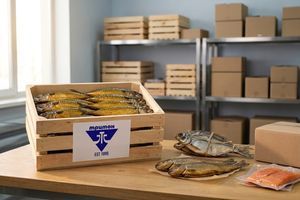
For hot dishes the most convenient choice is fresh-frozen fish. Triton's range in this category includes Norwegian salmon in several formats, from whole gutted fish to fillets and portion steaks, as well as Chilean salmon, redfish, Atlantic mackerel, herring, horse mackerel, blue whiting and tilapia. Salmon backbones and heads are sold separately. People buy them specifically for broth and fish soup, and on fasting weekends they become the base of a first course for the whole family.
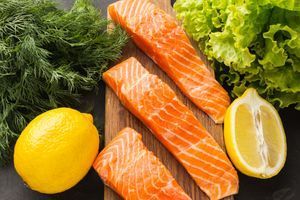
Each of these fish has its own role in the kitchen. Redfish has tender, lean flesh and a modest size of 300 to 600 grams, so one fish makes one or two portions. Mackerel is richer and is baked or smoked at home. Fresh-frozen herring is chosen by those who like to cure fish themselves to a family recipe. Salmon suits both a festive lunch and a quick dinner, when the fillet only needs salt and a spell in the oven.
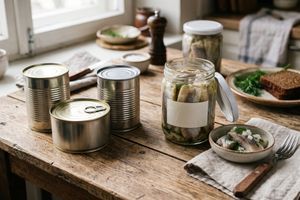
When there is no time to cook, fish preserves come in handy. The range includes herring fillet pieces in oil, marinated fillet, herring rolls in oil, with mustard seeds, with aromatic herbs and with vegetables in tomato, as well as matjes. The rolls are sliced into rounds and laid straight on the plate, with no need to take the fish apart. For a quick snack before a Saturday lunch, dried fish works well: classic taran and roach, the richer bream, or moonfish with soft flesh and few bones.
When choosing ready fish products for the fast, it pays to read the ingredients. Fish in oil, marinade or tomato sauce fits the fasting menu. Fish spreads, on the other hand, are made with butter, so they are kept for the Christmas season and served on the festive table.
How to plan shopping and thawing
The easiest approach is to buy fresh-frozen fish for several weekends at once and keep it in the freezer at −18 °C. Commercially frozen fish is kept within the best-before date on the pack, so a stock bought at the start of the fast lasts well into December.
Fish is thawed in the fridge, and it is best to plan this the evening before. A small piece of fillet thaws overnight, while a whole fish or a large pack may need a full day. So for Saturday lunch the fish comes out of the freezer on Friday evening, and for Sunday lunch on Saturday. When time is short, the fish in an intact sealed bag goes into cold water, which is changed every half hour. A pack of about half a kilogram thaws this way in roughly an hour and is cooked straight away.
Preserves and dried fish need no thawing, so they are kept in the fridge as a reserve for days when there is no time to cook. Unopened preserves are stored in the fridge at +2 to +6 °C, and Triton recommends keeping vacuum-packed dried fish there for up to 60 days.
What to cook with fish on fasting weekends
The first course of a fasting weekend is often yushka, the Ukrainian fish soup. Salmon backbones and a head make a rich broth, and all it needs is potatoes, carrots, onion, a bay leaf and fresh herbs at the end. After simmering, the fish is taken apart and the pieces of flesh go back into the pot. The soup turns out filling, and one pot usually lasts both days of the weekend.
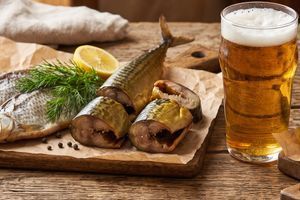
Redfish is baked whole on a bed of sliced onion and carrot drizzled with vegetable oil. The vegetables release their juice and keep the fish from drying out, and the result is a main course and a side dish in one. Mackerel is baked the same way or with lemon and herbs, while salmon fillet is pan-fried in vegetable oil or baked in foil with lemon and dill. Boiled potatoes, rice or buckwheat go well with any of these.
A fasting table almost always has herring with boiled potatoes, onion and oil. With preserves it is ready in a few minutes, because the fillet is already cleaned and cut. Those who like to salt fish at home buy fresh-frozen herring and cure it a week ahead, and then only the potatoes need boiling.
Pickles and salads help get through the weekdays without fish. Sauerkraut, pickled oyster mushrooms and champignons, and Korean-style salads of carrot, beetroot or aubergine are made with vegetable oil, vinegar, salt, sugar and spices, so they fit the fasting menu. In a closed container these salads keep in the fridge for 14 to 30 days, and for another 7 to 10 days after opening. A few packs cover a week.
How to prepare for Christmas Eve and Christmas
Christmas Eve, 24 December, ends the fast. By tradition, twelve meatless and dairy-free dishes are served at the Holy Supper, always including kutia and uzvar, and according to the OCU calendar food with oil is allowed on that day. Fish is no longer planned for the last week of the fast, and the shopping list turns to poppy seeds, honey, dried fruit, mushrooms and vegetables for varenyky and holubtsi.
Fish for the Christmas table is best bought in advance, while the fast is still on. From 25 December to 4 January the Christmas season lasts, and there is no fasting even on Wednesday and Friday, so fish spreads, smoked fish and salmon preserves all return to the festive table. After the season, on 5 January, comes Theophany Eve, and on that day the OCU calendar again allows food with oil.
Frequently asked questions
When does the Nativity Fast begin in 2026?
Is fish allowed on the feast of the Entry of the Theotokos?
Is fish allowed on Saint Nicholas Day in 2026?
Can you eat herring during the fast?
Is fish allowed on Christmas Eve?
Can you eat fish spread during the fast?
When do the restrictions end?
Fish for fasting weekends and the Christmas table can be ordered from Triton with Nova Poshta delivery to any city in Ukraine.