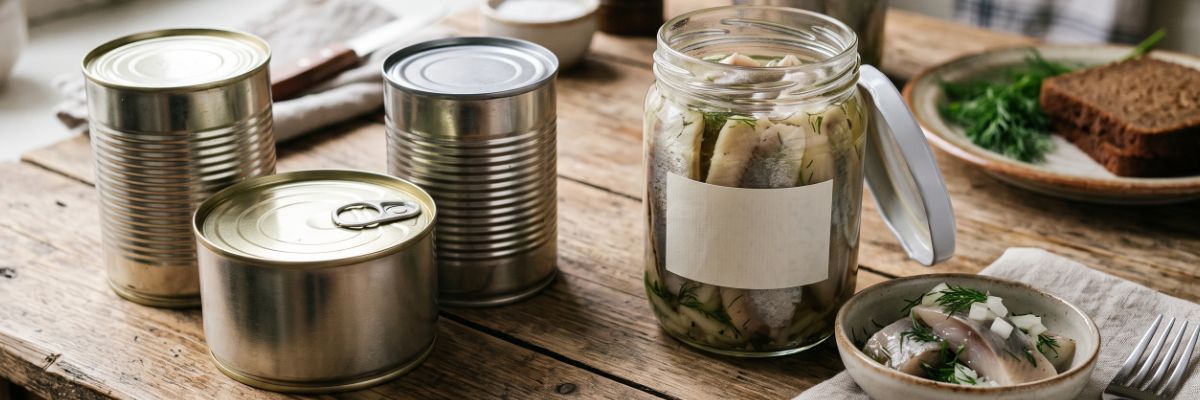
Fish Preserves vs Canned Fish: The Difference and What Matjes Herring Is
Fish preserves and canned fish are easy to mix up: the same fish, a similar jar, often neighbouring shelves. Yet one keeps for a month or two in the fridge while the other sits in a cupboard for years, and they are two different products with different technology, texture and purpose. Below we look at how they actually differ, what matjes herring is and why it costs more, how to read the label, and how long preserves last once opened.
What fish preserves are
Preserves are lightly salted fish or seafood packed in a filling of oil, marinade or sauce. Their defining feature is something that is not done to them: preserves are never sterilised. What holds the microflora back here is not heat but salt, the acidity of the filling and constant refrigeration.
That single fact explains both the main advantage and the main limitation. The fish stays close to fresh, with a fillet that is firm, juicy and properly structured. It also keeps the fish oil and its omega-3 fatty acids, part of which breaks down under prolonged heating. In exchange, the product lives only in the fridge, and its life is counted in weeks rather than years.
The raw material varies widely: herring, mackerel, salmon, sprat, mussels, squid and octopus. So do the formats, from whole fillets to pieces, rolls and seafood in spiced oil.
What canned fish is
Canned fish works the other way round. The fish is sealed into an airtight can and sterilised above 100 °C. The heat treatment destroys the microflora, so the can sits in a cupboard for years and needs no cold at all.
Texture is what pays for that. Sterilisation makes the flesh fall apart, softens the small bones and turns the flavour into that of cooked rather than salted fish. This is why canned fish usually goes into a dish as an ingredient, in soups, p但tés and salads, while preserves are served on their own.
Preserves, canned fish and salted fish: comparison table
In practice the choice at the counter is a three-way one, because plain salted fish sits on the same shelf. It also needs refrigeration, but it comes without a filling and is usually cured more heavily, so it behaves differently again.
| Parameter | Preserves | Canned fish | Salted fish |
|---|---|---|---|
| Processing | light salting and a filling, no sterilisation | sterilised above 100 °C in a sealed can | dry, brine or spiced salting |
| Where to store | fridge, +2…+6 °C | room temperature | fridge |
| Shelf life | 30–120 days unopened | years | stated on the pack |
| Texture | delicate, close to fresh fish | soft, falling apart, bones softened | firm and springy |
| Taste | fish together with the filling | cooked fish | pronounced salty |
| Readiness | ready to serve | ready to serve | often needs trimming and slicing |
| Typical use | canapés, platters, appetisers | soups, p但tés, salads | with potatoes, in salads, for home curing |
What matjes herring is
Matjes is not a separate species but a way of selecting and salting the fish. The name comes from the Dutch maatjesharing, used for young herring caught before spawning.
The whole difference lies in the age of the fish. Young herring has not yet spent its accumulated fat on roe and milt, so the fillet turns out fattier and softer, without the sharp smell and slight bitterness that mature fish can develop after heavy curing. Matjes is traditionally lightly salted so that the salt never overpowers the taste of the fish itself.
In the catalogue, matjes herring comes in two formats, and they are worth telling apart: one name covers two products meant for very different jobs.
Matjes in preserves and salted-frozen matjes
Matjes in preserves is ready to serve straight away. It is a headless, skinless, gutted fillet in a tray, kept in the fridge at +2…+6 °C. Open it, arrange it on a plate, and the work is done. This is the format people buy for home and for a festive table.
Salted-frozen matjes is a semi-finished product in bulk packing, used by producers, restaurants and caterers. It is stored in a freezer at -18 °C, which makes its shelf life far longer, but the fish has to be thawed in the fridge and trimmed by hand. It must never be refrozen.
The numbers in the name, 5-7 or 7-9, refer to how many fish go into the pack, which effectively describes the grade: the fewer fish in the same packing, the larger each one is. The exact weight per fish and the pack size are always shown on the product page.
Is Dutch-style herring the same as matjes?
No, although the two names get confused constantly. Dutch-style herring is a separate item in the catalogue: salted-frozen, headless, in its own packing. The name refers to a curing method that is gentler than the classic one.
The difference is in what each name actually describes. “Dutch-style” describes the curing method, and it can be applied to different fish. “Matjes” describes above all the age and fat content of the fish itself, meaning young herring taken before spawning, which is also cured in the Dutch tradition. That is why matjes is almost always lightly salted, while “Dutch-style” does not necessarily mean young fish. In taste both are gentler than a classic heavy cure and work equally well on bread and on a platter.
Why matjes costs more than ordinary herring
The near two-to-one price gap comes down to a few unglamorous facts. Matjes is caught in a narrow seasonal window, when the fish has built up fat but has not yet gone to spawn, and it is not just any herring from the batch but young fish of the right size and fat content. It is then skinned and boned, so the yield of finished fillet per fish is lower and the manual work higher. Add the light cure, which shortens shelf life and therefore makes storage and logistics more expensive, and you have that doubled price.
Paying extra is not always worth it. If the herring is destined for a dressed salad where mayonnaise, beetroot and onion will cover its flavour, ordinary lightly salted herring does the job just as well. Matjes earns its price where the fish is eaten as fish: on canapés, on a platter, with boiled potatoes.
What preserves the catalogue holds
The preserves category gathers dozens of own-production items, and the easiest way to navigate it is by format rather than by species.
The classics of the category are herring preserves, matjes included. Next to them sit fillets and rolls in various fillings: fillet pieces in oil, marinated fillet, and rolls in oil, with mustard seeds, with aromatic herbs and with vegetables in tomato. A roll is convenient because it can be cut into rounds and put straight onto a plate without trimming the fish.
Seafood in oil forms a group of its own: spiced mussels, large-grade mussels, octopus tentacles, baby octopus, a seafood cocktail with squid and mussels, and a Mediterranean version with shrimp and salmon. This is no longer herring-with-potatoes territory but an appetiser for white wine. There are also delicatessen items from salmon, notably pieces in oil and trimmings, along with cold-smoked sprat in oil.
The format follows the occasion: fillets and rolls when a ready platter is needed with no work involved, seafood when the plan is an appetiser with wine, and classic herring when it goes with potatoes and dark bread. For canapés the category pairs well with fish spreads and butters, that is, salmon, shrimp and capelin roe spreads.
How to read a preserves label
Because preserves are not sterilised, the label matters more here than it does on a can. Start with the composition: a natural preserve contains fish, oil or marinade, salt, sugar and spices. A long list of E-numbers standing in for those ingredients is reason enough to pick up a different jar.
The second point, rarely discussed, is ripening accelerators. They cut curing from days to hours and noticeably change the texture of the fish. We do not use them in production: only fish, sea salt and traditional technology.
Next, look at the production date rather than only the use-by date, because the fresher the batch, the more expressive the taste. A preserves label always carries a storage temperature range, and if the display cabinet in the shop is warm, none of the other figures matter any more. The last thing visible to the naked eye is the filling itself: oil or marinade should be clear, free of flakes and sediment, and cloudiness points to storage conditions having been broken.
How to store fish preserves
For preserves, refrigeration is not a recommendation but a condition of shelf life. Keep them in the fridge at +2…+6 °C, away from temperature swings and direct sunlight. Unopened, the shelf life runs from 30 to 120 days depending on the item, and the exact date is always printed on the label.
Once the jar is open, the product is best eaten within one to three days, transferred to a glass container with a tight lid. Preserves must not be frozen: as they thaw, the oil separates and the flesh turns watery and loses its flavour. Salted-frozen items behave in the opposite way, being kept at -18 °C, thawed in the fridge and never refrozen.
Items from this category can be ordered with Nova Poshta delivery, and delicatessen products travel in insulated packaging with cold packs.
How to serve preserves
Let the product stand at room temperature for 10–15 minutes before serving: cold fat gives away no flavour, while slightly warmed fat opens up fully.
The basic pairing for herring and matjes is dark bread with butter. Just as classically, the fish works with boiled potatoes in their skins and pickled onion. For canapés, fillets and rolls are the easier choice, since they hold their shape instead of falling apart. If you are building a fish platter, take two or three kinds of differing texture and saltiness and add lemon, olives and herbs. Seafood in oil is better served separately, as an appetiser with dry white wine.
Frequently asked questions
How do preserves differ from canned fish?
How long do preserves keep once opened?
Can preserves be frozen?
Matjes or ordinary herring, which to choose?
What do the numbers 5-7 and 7-9 in a matjes name mean?
Do preserves contain a lot of preservatives?
Summary
The whole difference between preserves and canned fish rests on one technological detail: preserves are not sterilised. Everything else follows from it, namely the fridge instead of the cupboard, months instead of years, and a delicate texture instead of a soft one. Matjes occupies the premium slot in that picture and justifies its price wherever the fish is served as a dish in its own right, while the salted-frozen version of the same fish belongs in the kitchen rather than on the plate. The simplest way to choose remains the label: the production date and the composition say more about a product than any description on the display.