Salmon, trout and Atlantic salmon are the most popular red fish on the Ukrainian table, yet the difference between them is often confused and the names are used loosely. Here is the explanation without the myths: how they differ biologically, how much omega-3, protein and vitamins they contain according to USDA data, why the flesh is pink, how wild fish differs from farmed, and how to choose and cook a quality product. This material was prepared by specialists of the “Triton” brand, a producer of fish products since 1993. This is general reference information, not medical advice.
Salmon, Trout and Atlantic Salmon: What Is the Difference
Salmon is not a single species but a collective name for several fish of the salmon family (Salmonidae). It includes both the Atlantic salmon and Pacific species, which belong to different biological genera. In the trade, “salmon” usually means a large red fish with a rich flavour and fatty flesh.
Atlantic salmon (Salmo salar), sold in this region under the name siomga, is one of the fattiest and most delicate red fish. In retail, “salmon” and “Atlantic salmon” are often used as synonyms, although strictly siomga means precisely Salmo salar, while “salmon” is a broader concept.
Trout is also a fish of the salmon family, but of separate species. The most common one on the market is the rainbow trout (Oncorhynchus mykiss). Interestingly, under modern classification the rainbow trout belongs to the same genus Oncorhynchus as the Pacific salmon — that is, biologically it is “closer” to pink salmon or coho than to the Atlantic salmon. Trout is usually smaller than salmon, with more tender and less fatty meat ranging in colour from light pink to orange.
What Kinds of Salmonids There Are
To find your way around a label, it helps to know the main species. All of them belong to the salmon family, but to different genera and species:
- Atlantic salmon (siomga), Salmo salar — genus Salmo. Large, fatty, delicate; the backbone of the red fish market.
- Pink salmon, Oncorhynchus gorbuscha — the smallest and leanest Pacific salmon, affordable in price.
- Chum salmon, Oncorhynchus keta — moderately fatty, with lighter, firm flesh; its roe is also valued.
- Coho salmon, Oncorhynchus kisutch — bright red flesh, rich flavour.
- Sockeye salmon, Oncorhynchus nerka — the brightest in colour, with a pronounced flavour.
- Rainbow trout, Oncorhynchus mykiss — the main farmed trout; its anadromous form is called steelhead.
Most Pacific salmon spawn once and die (this is a normal biological trait of the species), whereas the Atlantic salmon can spawn several times. This does not affect the taste or quality of the product, but it explains why pink and sockeye salmon are almost always wild Pacific fish, while Atlantic salmon and trout are predominantly farmed.
Salmon, Trout and Atlantic Salmon: Comparison Table
| Parameter | Salmon / Atlantic salmon | Trout |
|---|---|---|
| What it is | Atlantic salmon Salmo salar (siomga) and other large salmon | rainbow trout Oncorhynchus mykiss and related species |
| Flesh colour | rich orange | from light pink to orange |
| Fat content (per 100 g) | high, roughly ~13 g (farmed) | medium, roughly ~6 g |
| Omega-3 (EPA+DHA, per 100 g) | ~1.9–2.0 g | ~0.7 g |
| Taste | buttery, rich | delicate, mild |
| Approximate price | higher | more affordable |
The fat and omega-3 figures are given according to USDA reference data for raw fish; these are guidelines, since the actual values depend on the species, feed, season and the specific batch.
Why Salmon and Trout Have Pink Flesh
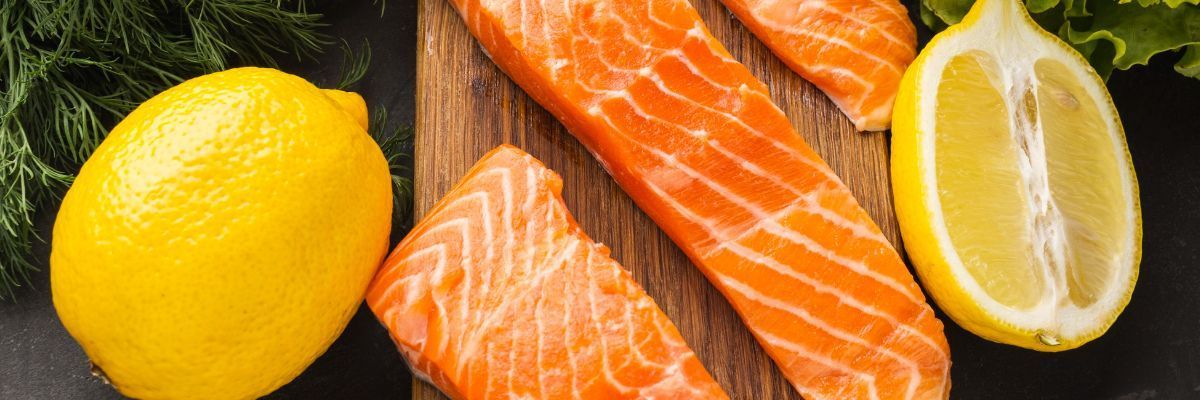
The red-orange colour of the flesh comes from the natural pigment astaxanthin — a carotenoid that the fish accumulates in its muscles. In wild fish, astaxanthin comes from the feed: shrimp, krill and other crustaceans, which in turn obtain it from microalgae. Farmed fish receive this same pigment from compound feed; without it the flesh would be a pale grey. It is important to understand that astaxanthin is not a “colourant for looks” but the very same natural nutrient that wild fish also accumulate. So a rich colour is not in itself a sign of “chemicals”: far more telling are the evenness of the colour, the smell and the firmness of the flesh.
Why Red Fish Is Good for You
Red fish is valued above all for its composition. Approximate figures per 100 g according to USDA data (raw fish):
- Omega-3 (EPA and DHA). Atlantic salmon — approximately 1.9–2.0 g per 100 g, rainbow trout — about 0.7 g. These are long-chain fatty acids that the body produces almost none of on its own, so it obtains them mainly from food.
- Protein. About 20 g per 100 g, easily digestible.
- Vitamin D. Red fish is one of the few natural food sources: farmed Atlantic salmon contains approximately 11 µg (about 440 IU) per 100 g.
- Vitamin B12 — roughly 3–4 µg per 100 g, above the daily requirement of an adult.
Omega-3 EPA and DHA are part of cell membranes, and DHA is especially abundant in the tissues of the brain and the retina of the eye. The American Heart Association advises eating fish about twice a week, giving preference to fatty species; one serving is approximately 85–100 g of cooked fish. At the same time, the official wording is cautious: studies “support but do not conclusively prove” that consumption of EPA and DHA may reduce the risk of coronary heart disease. Red fish is fatty and high in calories (farmed salmon — about 208 kcal per 100 g), so portions should be kept moderate. This is general information, not medical advice.
Salmon or Trout: Where There Is More Fat and Omega-3
If we compare by USDA reference data, the Atlantic salmon is roughly twice as fatty as the rainbow trout (about 13 g versus about 6 g of fat per 100 g) and contains roughly 2.5–3 times more omega-3 (EPA+DHA). They have nearly equal protein — about 20 g. That is why salmon is “more buttery” and richer, while trout is lighter and more delicate in taste. Among the Pacific species, the leanest is the pink salmon: it has roughly about 4.4 g of fat per 100 g. Neither option is absolutely “better” than the other: salmon wins on fatty-acid content, trout on lightness and price. All these figures are guidelines, since the fat content of farmed fish depends greatly on the feed.
Wild or Farmed Red Fish
The vast majority of Atlantic salmon and trout on the market is farmed (aquaculture): by estimates, about three quarters of the world’s salmonid production today is raised, and very little wild Atlantic salmon remains in general sale. This is normal for this fish. Wild and farmed differ in composition: farmed is usually fattier and higher in calories, while wild has a better balance of fatty acids (a lower ratio of omega-6 to omega-3). The common myth that farmed fish “has no omega-3” is inaccurate: because of its greater fat content, a portion of farmed salmon can provide just as much or even slightly more omega-3 in absolute grams. Modern studies also show that the content of contaminants in both wild and farmed fish stays well below the limits established in the EU, so both are safe provided they are of good quality and fresh. The conclusion is simple: be guided not by the word “wild” on the label, but by the quality of the specific product, the feed, the rearing conditions and the producer’s reputation.
Which Red Fish to Choose for Different Dishes
The choice depends on the dish:
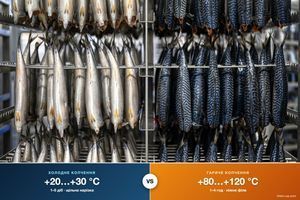
- For slicing and canapés — cold-smoked or lightly salted salmon: it is firm and holds its shape. More on the methods — in the article on cold and hot smoking.
- For a steak on the grill or in the oven — fresh-frozen salmon or trout.
- For salads and pâtés — salmon trimmings and belly, lightly salted fish.
How to Cook Salmon and Trout
Red fish cooks quickly; the main thing is not to overdry it. A few basic methods:
- In the oven. A steak or fillet is baked at 180–200 °C for approximately 12–18 minutes depending on thickness.
- In a pan or on the grill. Pan-fried for 3–4 minutes on each side, starting with the skin.
- Steamed. The most delicate method, it preserves juiciness; approximately 10–15 minutes.
The oven time and temperature are culinary guidelines; they depend on the thickness of the piece and on technique. The only safety indicator is the internal temperature: fish is considered done when, at its thickest point, it has heated to approximately 63 °C (145 °F). Without a thermometer, judge by appearance: cooked fish turns matte white and flakes easily with a fork. Delicatessen items — lightly salted salmon, belly (tesha), cold-smoked slices — do not require heat treatment and are served straight away. Before cooking, it is enough to salt and pepper the fish and sprinkle it with lemon.
Fresh or Thawed Red Fish
In Ukraine most salmon and trout are sold frozen or chilled-from-thawed — this is normal for imported fish. Properly frozen fish is almost as good as chilled, provided storage conditions are observed and there has been no refreezing. Signs of correct freezing: a thin, even glaze, the absence of large ice crystals and yellow patches, firm flesh after thawing. It is better to thaw fish slowly, in the refrigerator, rather than in water or a microwave — that way it loses less juice and texture.
How to Choose Quality Red Fish
- 1 Colour. Naturally even, without bright yellow or grey patches. Light streaks of fat between the segments of meat are normal.
- 2 Smell. Fresh and marine, without a sharp “fishy” or ammonia note.
- 3 Firmness. The flesh is firm and springs back after light pressing, with no excess liquid in the packaging.
- 4 Packaging and producer. A vacuum pack with an intact date, from a producer with its own production and a known reputation.
The “Triton” brand produces over 300 names of fish products of its own manufacture, including salmon and trout: fresh-frozen, lightly salted and cold-smoked. You can order with delivery by Nova Poshta across Ukraine or buy at our branded stores.
How to Store Red Fish
- Keep fresh-frozen fish in the freezer; thaw it slowly in the refrigerator and do not refreeze.
- Store lightly salted and smoked fish in the refrigerator, roughly for a few days.
- In vacuum packaging the shelf life is longer, but once opened the fish should be eaten within a few days.
The exact shelf life is always stated on the packaging — be guided by that first and foremost.
Frequently Asked Questions
How does Atlantic salmon (siomga) differ from salmon?
Which is healthier — salmon or trout?
Why is the flesh of red fish pink or orange?
Is wild or farmed red fish better?
How do you tell that fish is cooked?
How many times a week can you eat red fish?
Summary
Salmon, trout and Atlantic salmon are close but different fish. Atlantic salmon (siomga) is the fattiest and most delicate; under the name “salmon” a large fatty red fish is sold; trout is more tender, lighter and more affordable, and biologically closer to the Pacific salmon. By composition, salmon is richer in omega-3, trout is lighter. Choose according to the dish and taste, and when buying be guided by freshness and quality from a trusted producer.